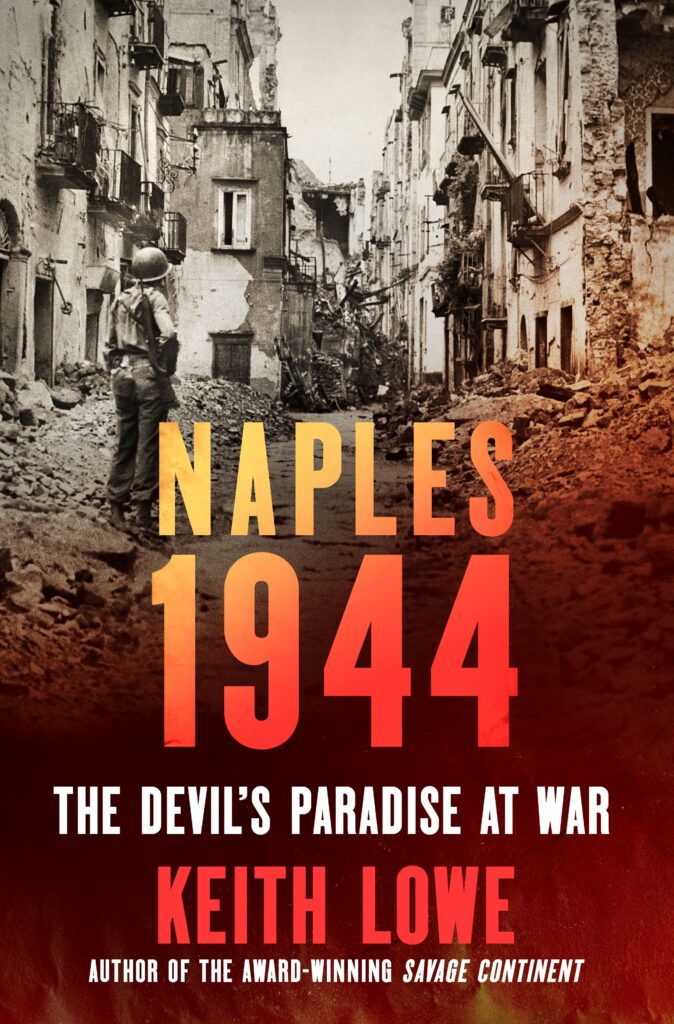
Naples 1944
Naples was the first major city in mainland Europe to be liberated by the Allies, and for almost a year it stood at the epicentre of the war in the Mediterranean. While its people continued to suffer air raids, famine, plague and even volcanic eruptions, the Allies had to stumble their way through a series of political and economic crises that would eventually lay the foundations for Italy’s postwar future.
The story of wartime Naples is central to the history of the war, and Italy’s return to democracy. Based entirely on primary sources, this is the first book in the English language to tell that story in full.

Prisoners of History
Prisoners of History is a ground-breaking and controversial look at our monuments and what they mean to us. If they are symbols of our history, then whose history do they represent? And if they are built to remind us of the values that made us who we are, then what happens when those values change over time?
This is global tour of our Second World War monuments – from Berlin to Moscow, Seoul to Hiroshima, the Philippines to Israel. Written at a time when statues around the world were being torn down by both governments and protesters, it is a timely look at some of the world’s most important symbols of our collective past.

The Fear and the Freedom
The Second World War was one of the most catastrophic events in human history. But how did the experience and memory of bloodshed affect our lives?
The world that emerged after 1945 was entirely different to the world that had gone to war. The European empires were swept away, and replaced with two new superpowers in a new, global Cold War. Scientists had delivered new technologies, politicians had begun to fantasize about overhauled societies, some argued for global government, others for independence. The postwar era was one of wonder and terror, and it resonates in the arguments about nationalism, immigration and globalisation that we have today.

Savage Continent: Europe in the Aftermath of World War II
The Second World War left Europe in a state of chaos. In this groundbreaking history of the aftermath of the war, Keith Lowe describes a continent still racked by violence and lawlessness. He outlines the insatiable urge for vengeance that was the legacy of the war; the ethnic cleansing and civil conflict that tore apart the lives of ordinary people everwhere; and the establishment of a new world order that finally brought stability to a shattered continent. These were themes, he shows, that existed across the whole of Europe – east and west.
Based on original documents, interviews and scholarly literature in eight languages, Savage Continent is a window on the brief, chaotic period between the end of World War II and the beginning of the Cold War. It is the first major history of the aftermath of the war in any language.

Inferno: The Devastation of Hamburg 1943
The Hamburg firestorm was one of the most terrifying acts of destruction the world has ever seen. In this critically-acclaimed history, Keith Lowe describes how desperate families survived both the bombing of Hamburg and the superheated, hurricane-force winds that swept the city afterwards. The fires caused by the bombing were so huge they burned for a month, and were visible for 200 miles.
Based on interviews, letters, diaries, official reports and captured German documents, Inferno is the first comprehensive account of the Hamburg firestorm for almost thirty years. “Facts and figures cannot do justice to the sheer horror of what happened to Hamburg in July 1943. But Keith Lowe’s admirable book, which is impeccably researched and engagingly written, is full of moving little details and stories. A thoroughly engaging and sobering book. There are rather too many military histories of the Second World War, but this one deserves its place on the shelves.” – Dominic Sandbrook